

Labs run out of critical reagents.
Often. Experiments stop. Delays happen. You know the headache.
Managers don’t just lose patience, they spend hours tracking spreadsheets, updating legacy LIMS modules and praying nothing explodes mid-week.
Some studies show over 40% of reagents are over-purchased and expire before they’re used. Others highlight experiments delayed for days because of slow deliveries. That’s the hidden pain most labs live with daily.
Why automate lab inventory?
It’s simple: spreadsheets aren’t enough. Old LIMS modules only warn after stock runs out, which is exactly when the headache starts.
Multiply multiple reagents, multiple suppliers and multiple projects (hello, CROs and CDMOs) and manually tracking inventory becomes a nightmare.
Do we need more reasons to automate lab inventory?
We decided we don’t.
Introducing Smart Inventory in custom LIMS
Part #5 of our “Custom LIMS features for hidden lab pains” series is all about solving this exact issue.
Here’s what our smart inventory feature does:
- Track usage patterns and supplier trends: watches your lab data, notices spikes and tracks deliveries.
- Learn implicitly from real lab behavior: the more you use it, the smarter it gets, almost like it knows your lab.
- Predict low stock before it happens: no more “Oops, we’re out”. Just early alerts and foresight.
- Recommend how much to order and from whom: based on supplier reliability, past performance and usage patterns.
How it works
Normal stock monitoring
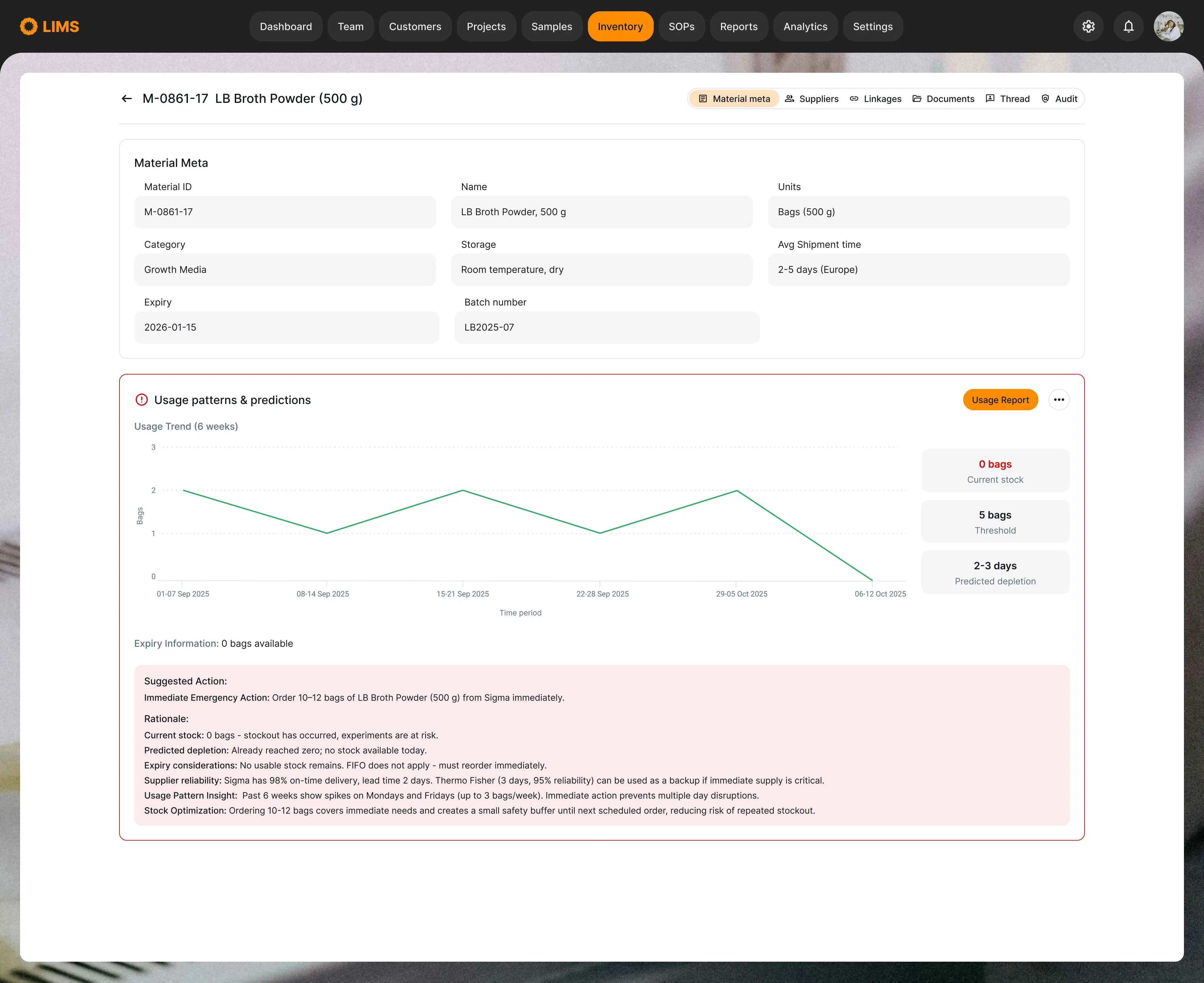
- Suggested Action? Order 10-12 bags of LB Broth Powder (500 g) from Supplier#1 immediately.
- Why? Stock is 0, experiments are at risk.
- Predicted depletion? Already reached zero.
- Expiry? No usable stock remains.
- Supplier reliability? Supplier#1: 98% on-time, 2-day lead time. Supplier#2 backup: 95% on-time, 3 days.
- Usage insights? Past 6 weeks show spikes on Mondays and Fridays.
- Stock optimization? Ordering 10-12 bags creates a small buffer, preventing repeated stockouts.
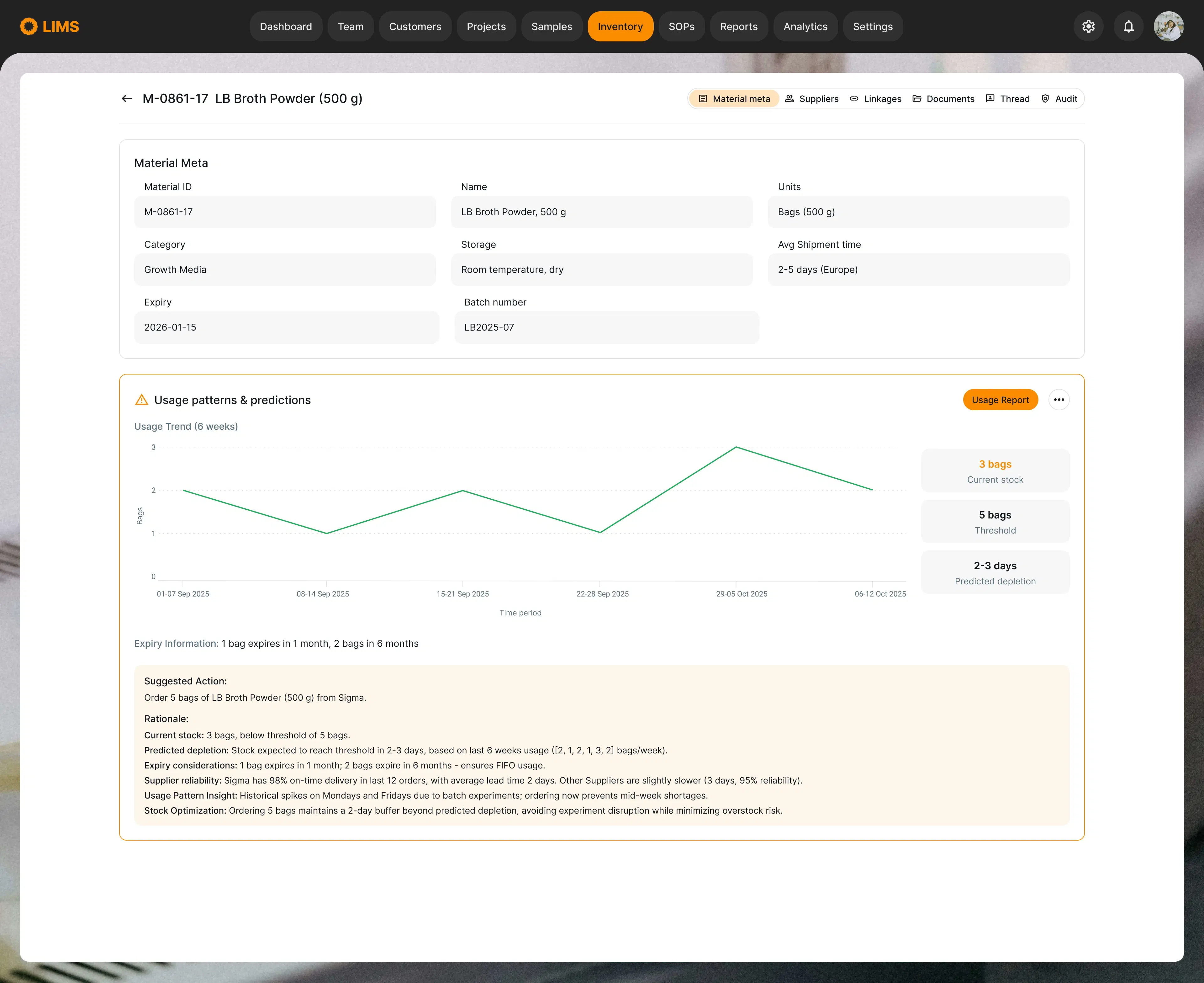
Critical shortage
The system highlights a critical shortage visually (red alert).
Instant guidance: "Order 10-12 bags immediately, stock is zero, experiments at risk". Includes expiry considerations, usage insights and supplier reliability.
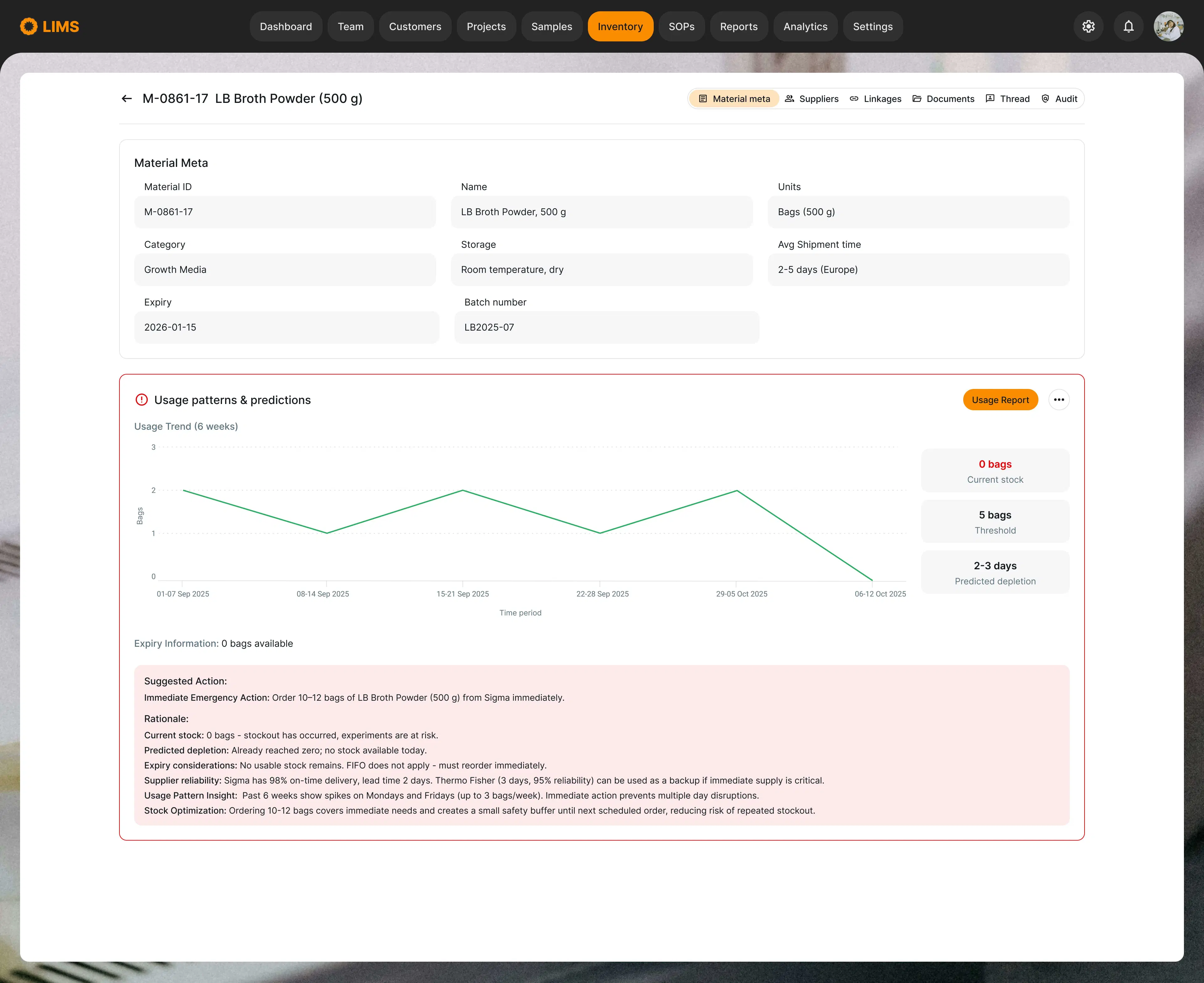
Dashboard notifications
Instant alerts on the dashboard the moment a reagent hits critical levels.
Ensures lab managers are aware immediately.
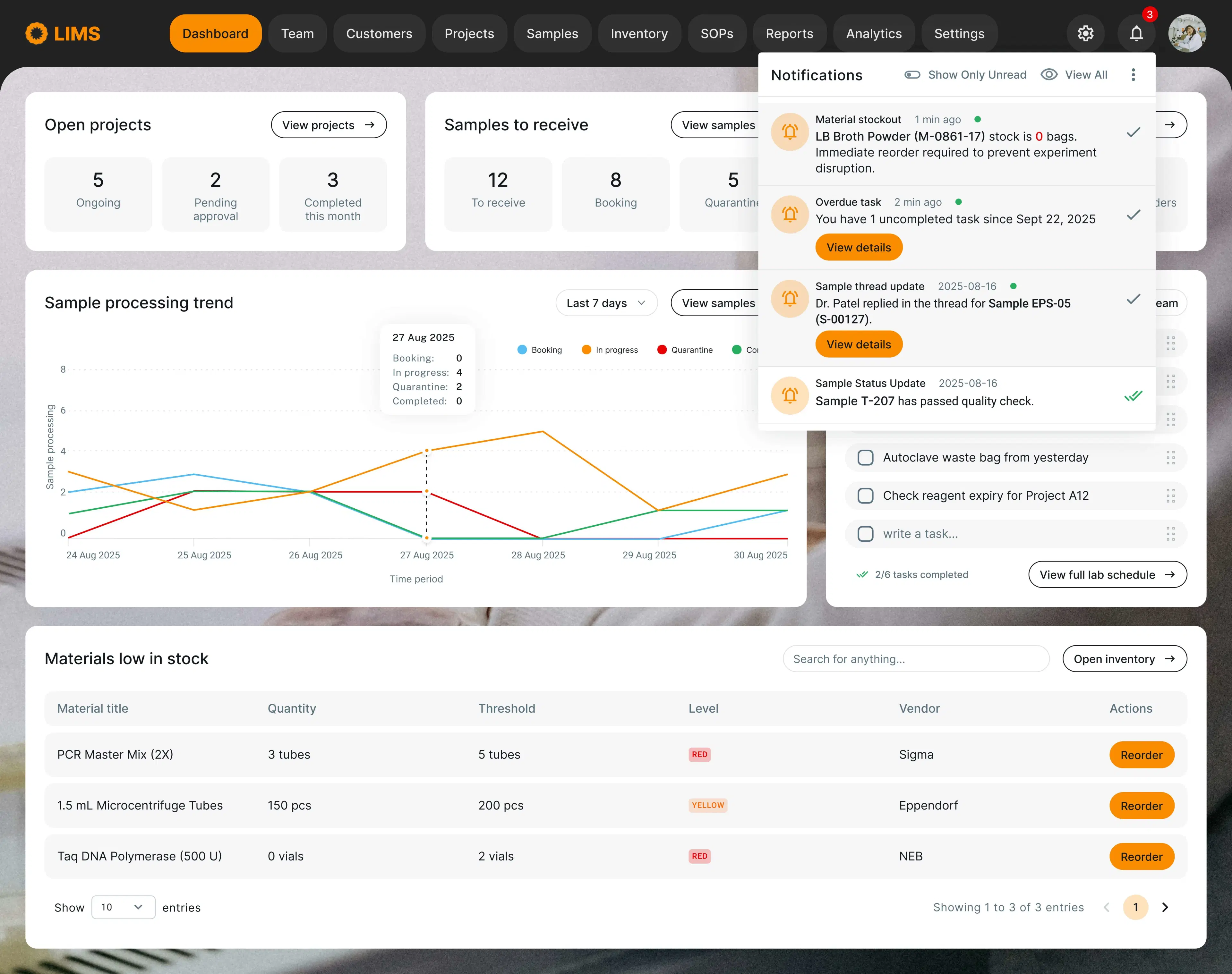
Supplier history & insights
Tracks delivery times, reliability and past issues. Helps decide whom to reorder from and when.
Example: Supplier#1 - 2-day avg delivery, 98% on-time; Supplier#2 - 3-day avg, 95% reliability.
Makes stock planning smarter and safer, reducing risk of repeated shortages.
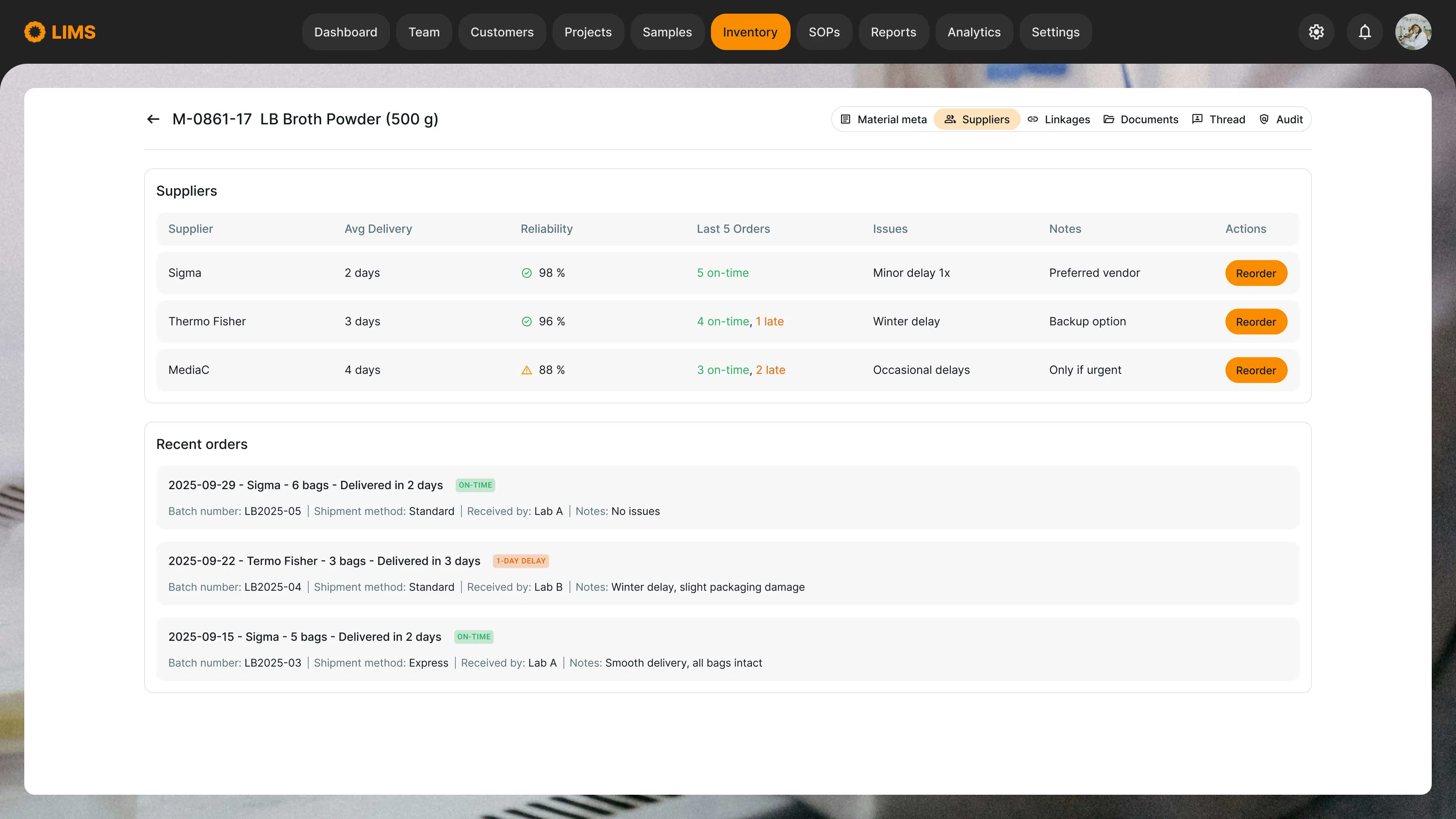
Implicit learning at work
The more you use it, the more the system learns your lab’s behavior. Recognizes patterns, spikes and recurring trends.
Over time, it predicts stock needs more accurately and tailors suggestions to your lab’s rhythm.
The results
- Fewer stockouts, fewer delays
- Reduced waste, no more expired reagents
- Smoother experiments and less manual work
- Data-driven supplier decisions